Own product · Android
Nept Track
A private, offline-first daily planner that combines a habit tracker, budget planner, notes, a sketch whiteboard and a capture inbox in one app, with no sign-up. Built with Expo, React Native, SQLite and custom Kotlin modules, and live on Google Play.
None
Account required
100%
Works offline
6
Custom native modules
16
Languages
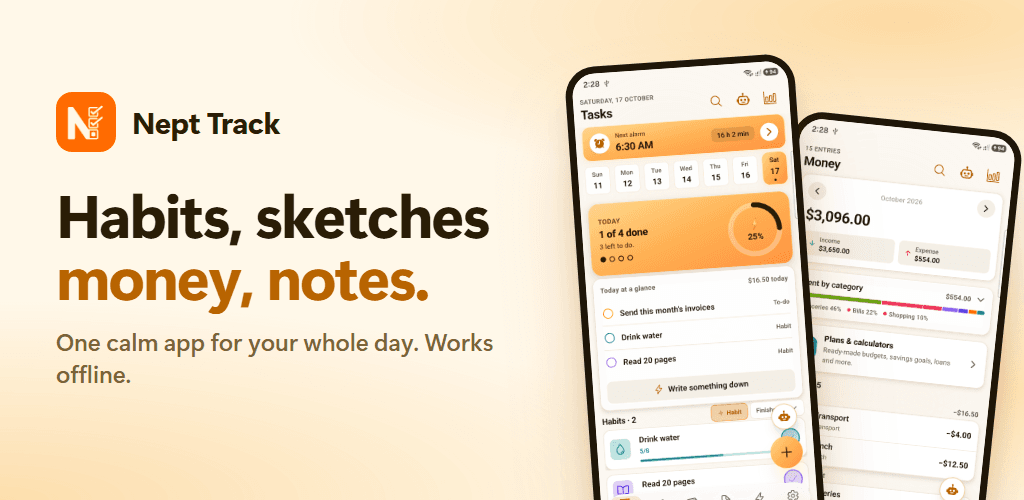
Most people run their day across five apps: a habit tracker, a money app, a notes app, a to-do list and a reminder app. Every one wants an account, every one keeps your data on its own servers, and none of them can tell you how your day actually went.
Nept Track is my answer to that. It is one private planner for habits, money, notes, sketches and quick captures. It works fully offline, needs no sign-up, and keeps every record on the phone. It is live on Google Play.
The problem
Three things make an app like this harder than it looks.
Speed decides whether people keep using it. If logging a coffee or ticking off a habit takes more than a few seconds, people stop doing it within a week. Every main action had to be one screen and one tap away.
"Offline" has to mean offline. Many apps say they work offline but quietly need a server for reminders, backups or charts. Nept Track had to do everything on the device, including exact alarms, reports and search.
Personal data deserves real privacy. Habits, spending and notes are some of the most personal data a phone holds. The privacy promise had to be built into the code, not just written in a policy.
What I built
Capture first, sort later
The centre of the app is a capture inbox. You write anything in one tap without choosing where it goes, then turn it into a task, an expense or a note later. Simple text parsing helps: typing "Spent 450 on transport" offers to log a transport expense for 450. Text shared from any other app lands in the same inbox through a custom Android share-intent module.
Habits that feel fair
Habits can run on any days of the week, with goals such as "8 glasses a day". Streaks only count scheduled days, so a rest day never breaks a streak, and only days that were due can be marked as missed. A 12-week heatmap and a 0–100 consistency score for any date range make progress easy to read without shaming people for a bad week.
Reminders and focus that actually fire
Scheduled notifications are not reliable enough for alarms on many Android phones, so I wrote a native Kotlin alarm-clock module that uses exact alarms, with a different sound for each habit and quiet hours. A second module powers focus time: it turns on Do Not Disturb for a deep-work block and restores the sound when the block ends.
Money without the stress
Income and expenses are logged amount-first in seconds. Monthly budgets per category warn at 80% and when they go over, and the app shows the daily average and a projection for the month. A built-in calculator turns a sum straight into an expense, past expenses repeat in one tap, and a monthly report can be shared as PDF or CSV.
Notes and a sketch whiteboard
Notes support headings, checklists, colours, pins, tags, photos and PDF attachments, with a native PDF renderer for reading files inside the app. Version 2.3 added a Skia-powered whiteboard with an endless dot-grid canvas, selection, layers and templates such as a mind map, weekly plan, kanban and journal.
An assistant that respects privacy
Ask Nept is an optional AI assistant backed by Google Gemini. It is off until the user turns it on. It only ever receives summaries the app has already computed, such as how often each habit was done and spending per category. Note text, captures and individual transactions never leave the phone. It falls back across several Gemini models when one is busy, and it can create habits, alarms, notes and expenses on request.
Technical approach
- Expo + React Native + TypeScript for the app itself.
- SQLite with Drizzle ORM as the single source of truth, with typed schemas and migrations. Zustand only holds UI and settings state, so the data layer stays clean and ready for optional sync later.
- Six custom Kotlin Expo modules for things JavaScript cannot do reliably: exact alarms, Do Not Disturb focus mode, home-screen widgets, share intent, PDF rendering and saving straight to Downloads.
- Skia for the whiteboard, Reanimated for springy motion, and react-native-gifted-charts for charts.
- A warm amber design system with light and dark themes, a per-item accent colour, and full support for right-to-left languages like Arabic.
- Biometric app lock, plus backup export and restore so moving to a new phone never means losing data.
Outcome
Nept Track is live on Google Play in 16 languages, with a steady release cycle. The project covers the full product lifecycle: product strategy, UX and visual design, offline data architecture, native Android development, AI integration, app store optimisation and release management.
If you need a mobile app that is fast, private and genuinely useful offline, this is the kind of product I build.
Built with