AIAgentsArchitectureBackend
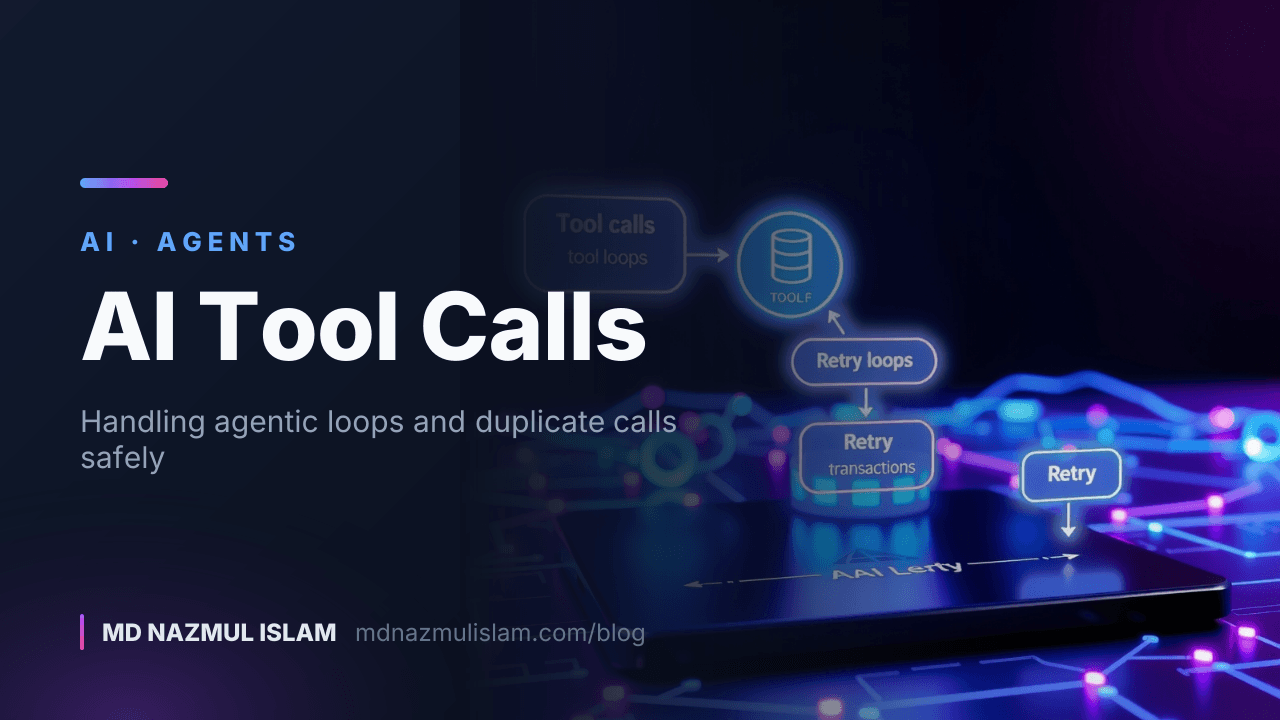
Optimizing AI Tool Calls and Managing Agentic Loops
November 17, 20265 min read7 views0 comments
Learn how to handle duplicate AI tool calls, resolve race conditions, and build resilient agentic loops for your applications.
Optimizing AI Tool Calls and Managing Agentic Loops
Hello there! As a full-stack developer who builds web applications, mobile apps, and custom SaaS products for clients worldwide, I spend a lot of time integrating modern AI features. Recently, the development community has been buzzing about agentic workflows, autonomous loops, and how LLMs interact with external tools. If you have ever watched an AI agent execute a task, you have probably noticed some quirky behaviors. Sometimes an agent retries a tool call because it thinks the first one failed, even though the first one actually succeeded behind the scenes.
In this post, we are going to break down why this happens, what it means for your application architecture, and how you can build safe guardrails around your AI systems to prevent duplicate actions, corrupted data, and wasted API costs.
The Reality of Non-Deterministic Tool Execution
When we build traditional software, function execution is strictly deterministic. If a user clicks a button to save a profile, our frontend fires a single HTTP request to our backend API, our database handles the transaction, and a clear success or error response returns to the user. We rarely worry about the database transaction succeeding while the client thinks it failed.
With Large Language Models and AI agents, the execution path is probabilistic. An agent plans a sequence of steps, generates arguments, invokes a tool, and then reads the tool's response to decide its next move. Problems arise when:
- Network latency causes a timeout on the client side, prompting the agent framework to automatically retry the tool call.
- The tool execution actually succeeded on your server, but the network connection dropped before the confirmation payload could reach the agent.
- The LLM gets confused by the wording of a successful response and assumes an error occurred, firing the exact same database write or API mutation a second time.
If your tool is a read-only query, a duplicate call is harmless. But if your tool updates a user's subscription, charges a payment gateway, or writes a new record to your database, a duplicate tool call can lead to serious bugs, duplicate charges, or data corruption.
Designing Idempotent Backend Tools
The most effective defense against accidental duplicate tool calls is strict idempotency. In simple terms, an idempotent operation can be applied multiple times without changing the result beyond the initial application.
Tagged with
AIAgentsArchitectureBackend
Comments
Leave a comment