Next.jsFull-Stack DevelopmentMongoDBREST APIMovie WebsiteWeb PerformanceResponsive DesignCase Study
How I Built Goldmines Picture: A Full-Stack Movie Discovery Website
July 26, 20268 min read232 views0 comments
A practical case study on building a fast, responsive movie discovery platform with Next.js, MongoDB, REST APIs, search, watchlists, and an admin-managed catalogue.
How I Built Goldmines Picture: A Full-Stack Movie Discovery Website
Goldmines Picture began with a straightforward product idea: make a growing catalogue of movies and series easy to explore. The difficult part was not displaying posters. It was building a discovery system that remained clear as the catalogue gained more genres, languages, release dates, cast information, ratings, and related titles.
This article explains the product and engineering decisions behind the website. It covers information architecture, frontend composition, API design, MongoDB query patterns, content management, responsive behavior, and the performance choices that matter for an image-heavy entertainment platform.
Defining the real product problem
A movie platform serves several types of intent at the same time. One visitor may know exactly what they want and use search immediately. Another may arrive without a title in mind and browse the latest releases. Someone else may filter by genre, language, year, actor, or series.
That meant the homepage could not be a long, unstructured wall of posters. It needed clear discovery paths:
A featured area for timely or high-value content
Search for direct title-based navigation
Latest movie and series sections for casual browsing
Genre and language filters for catalogue exploration
Ratings and metadata for quick comparison
Watchlists and favourites for returning visitors
Detail pages that connect titles, actors, and related content
These paths became the foundation of both the interface and the underlying data model.
Building a visual system for entertainment content
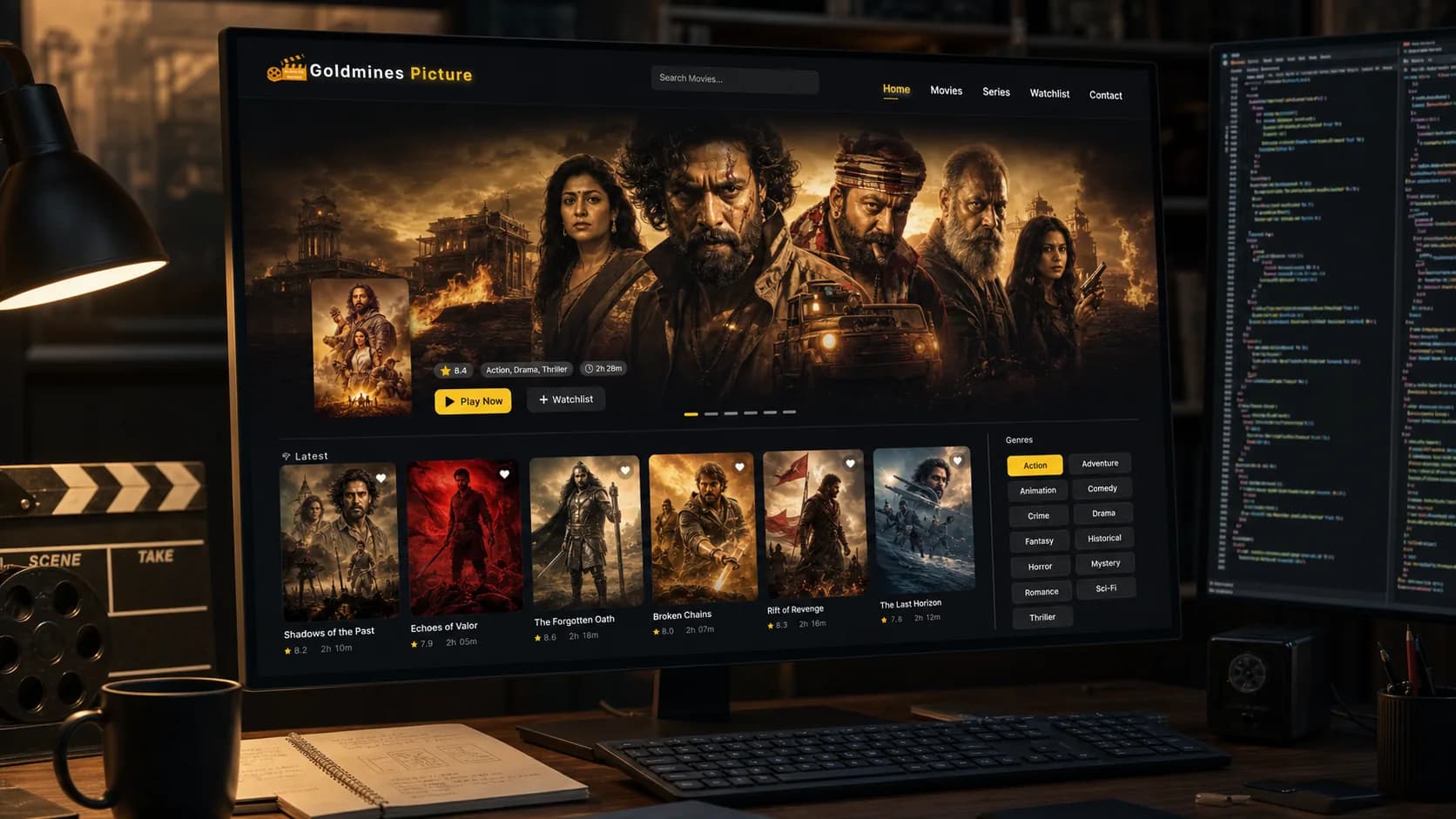
Goldmines Picture uses a near-black foundation with warm gold accents. The dark surface keeps poster artwork visually dominant, while gold marks active navigation, ratings, important actions, and selected filters. White and muted gray text provide hierarchy without competing with the imagery.
The goal was consistency, not decoration. The same rules apply to:
Navigation and search
Featured content controls
Movie and series cards
Filter chips
Rating indicators
Tagged with
Next.jsFull-Stack DevelopmentMongoDBREST APIMovie WebsiteWeb PerformanceResponsive DesignCase Study
Comments
Leave a comment
Watchlist actions
Loading and empty states
A consistent visual language makes a dense catalogue easier to scan. Users learn what gold means, where metadata appears, and how cards behave without relearning the interface in every section.
Designing reusable frontend components
The website is built around reusable React components within Next.js. Instead of creating separate markup for every catalogue area, I used a small set of composable pieces:
Content cards for movies and series
Horizontal and responsive content rails
Featured hero content
Search and filter controls
Metadata groups for year, duration, language, and rating
Detail-page sections for cast and related titles
Shared loading, error, and empty states
This approach reduced duplication and made behavior more predictable. A change to image treatment, metadata order, or card interaction can be applied across the product from one component rather than corrected screen by screen.
Next.js also provided a useful structure for page-level metadata, share previews, and SEO-friendly routes. A movie discovery site benefits when each public detail page has a descriptive title, summary, image, and canonical URL instead of relying on one generic site description.
Structuring the catalogue in MongoDB
Entertainment records contain a mixture of stable fields and flexible relationships. A title may include:
Name and alternative names
Release date and year
Movie or series type
Genres and languages
Runtime and rating
Poster and backdrop images
Synopsis and status
Cast and crew references
Related or recommended titles
MongoDB was a practical fit for this content because document records can represent rich metadata while still supporting indexed search and filtering. Flexibility, however, does not remove the need for discipline. Field names, normalized values, and predictable arrays are important when multiple interfaces depend on the same catalogue.
I kept filtering values such as type, year, genre, and language consistent, then designed indexes around the queries the interface performs most often. The goal was to make common discovery requests inexpensive rather than expecting the database to scan the entire catalogue for every page.
Keeping REST API responses focused
The homepage does not need every field stored on a movie record. A card may require only an identifier, title, image, year, rating, and a small category set. A detail page needs the full synopsis, cast, related titles, and richer metadata.
Separating summary responses from detailed responses has several benefits:
Smaller payloads reach the browser faster.
Less data must be parsed and retained in memory.
The API contract communicates what each screen actually needs.
Detail-only fields can evolve without bloating catalogue lists.
I also treated filter, pagination, and search parameters as part of a stable public contract. Consistent response shapes make the frontend easier to cache and reduce special cases in component code.
Search, filters, and discovery
Search is most useful when it feels immediate but does not overload the server. The interface delays requests briefly while the user types, cancels stale work where possible, and displays useful loading feedback. On the database side, normalized searchable fields and indexes support predictable query behavior.
Filters are designed to work together. A user may want an action movie in a specific language and year, so the API needs a clear way to combine constraints. The UI, meanwhile, must show what is active and make resetting the result simple.
Good discovery also depends on sensible defaults. Latest and featured sections give visitors a meaningful starting point before they enter any query.
Responsive design beyond smaller cards
Responsive design is not only a change in column count. On smaller screens:
Navigation must remain reachable without crowding.
Search needs enough width to be useful.
Featured content must preserve readable contrast over imagery.
Tap targets need more space than desktop pointer targets.
Metadata may need to wrap or become more concise.
Content rails should communicate that additional items are available.
I tested the content hierarchy at multiple widths and prioritized the information needed for a decision: title, image, category, year, rating, and a clear next action. Secondary details remain available on the title page.
Admin-managed publishing
A catalogue product becomes expensive to maintain if every title requires a code change. The administrative workflow separates content publishing from application deployment.
Authorized administrators can create and update catalogue records, attach images, organize metadata, and control what appears in discovery sections. Validation protects required fields and keeps values consistent before they reach the public site.
This separation matters for long-term operation. Developers can improve the platform while content managers continue publishing through a purpose-built workflow.
Performance decisions for an image-heavy platform
Poster and backdrop images are usually the heaviest part of a movie interface. I focused on:
Correctly sized responsive images
Stable aspect ratios to avoid layout movement
Lazy loading for content below the first viewport
Lightweight list responses
Cached catalogue requests
Indexed MongoDB filters
Clear skeleton states instead of blank gaps
Performance is a product feature here. Slow images or delayed filtering make discovery feel unreliable even when the underlying content is excellent.
Handling empty, loading, and failure states
Real products are not always in their ideal state. Search may return no result, an image may be unavailable, or the API may temporarily fail. I designed these outcomes as first-class interface states.
A useful empty state explains why nothing is visible and offers a recovery path, such as clearing filters. Image fallbacks preserve card geometry. Loading skeletons match the final layout so the page does not jump as data arrives.
These details improve trust because the product remains understandable when conditions are imperfect.
What this project demonstrates
Goldmines Picture is a useful example of full-stack product work because the challenge spans more than one layer:
Product discovery and information architecture
Responsive, reusable frontend components
API contracts and catalogue data modeling
Database query planning
Content administration
Image and page performance
SEO and share metadata
The most important lesson was to design around user intent rather than around database records. Once the discovery paths were clear, frontend components, API endpoints, and indexes could all support the same product model.
Frequently asked questions
Why use Next.js for a movie discovery website?
Next.js provides a strong structure for React interfaces, route-level metadata, server-aware rendering options, and optimized delivery. Those capabilities are valuable when catalogue detail pages need to be discoverable and shareable.
Why use MongoDB for the catalogue?
Movie and series records contain rich, evolving metadata. MongoDB supports flexible documents, but consistent schemas and indexes are still essential for reliable filtering and search.
How do you keep a poster-heavy website fast?
Use correctly sized responsive images, lazy loading, stable aspect ratios, smaller API payloads, caching, pagination, and database indexes designed around actual catalogue queries.
Can the same backend support a mobile app?
Yes. A stable REST API can serve both web and mobile clients. Summary and detail endpoints help each interface request only the data required for its current screen.
Final thoughts
Building Goldmines Picture reinforced a principle I use across full-stack projects: successful interfaces, APIs, and databases should express the same product structure. When those layers agree, the application is easier to use, optimize, and extend.
The finished website combines cinematic presentation with practical discovery tools and an administration workflow that can support continued catalogue growth.