React NativeExpoCross-PlatformMobileTypeScriptAndroid App DevelopmentCross-Platform DevelopmentMobile App DevelopmentMVP DevelopmentReact Native DeveloperBusiness Mobile AppsApp Development CostStartup App Development
React Native Cross-Platform App Development: Zero to Production with Expo
July 1, 20265 min read155 views0 comments
Learn how React Native and Expo help businesses build Android and iOS apps from one codebase, reduce costs, launch faster, and simplify maintenance.
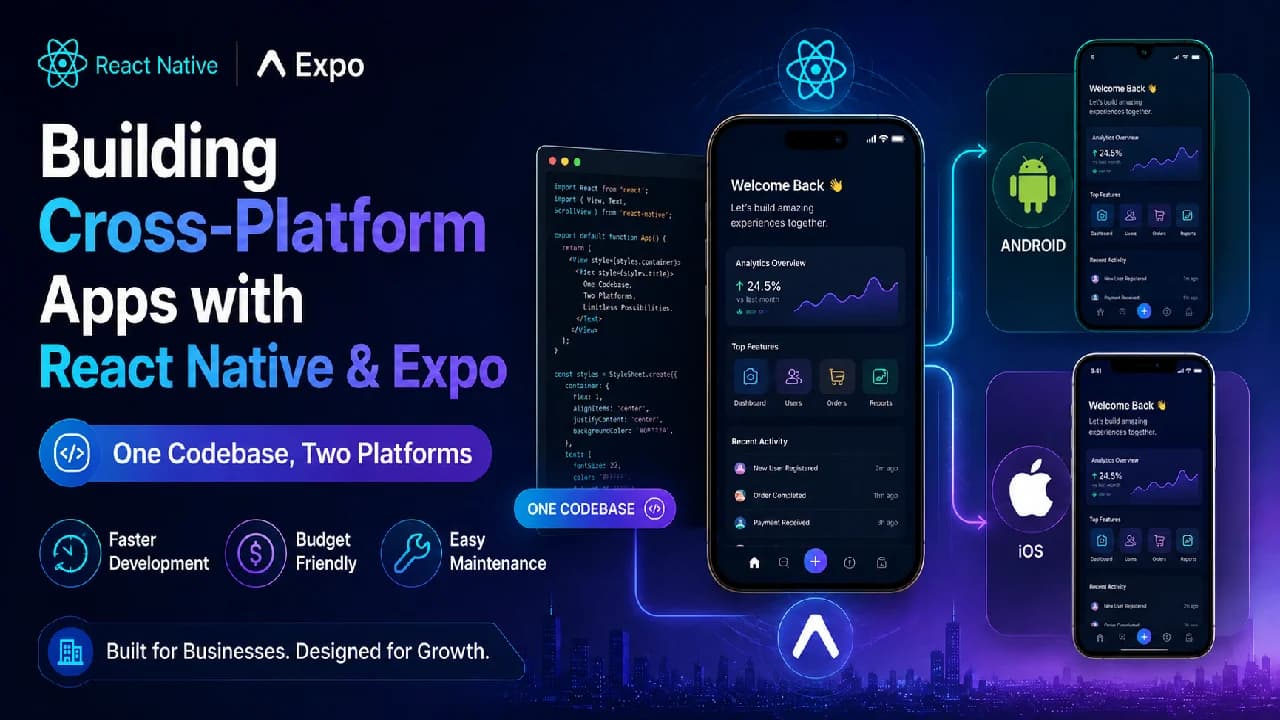
Businesses no longer need to build two completely separate applications to reach Android and iOS users. With React Native and Expo, developers can create modern cross-platform mobile applications using one shared codebase.
This approach helps businesses reduce development costs, launch faster, simplify maintenance, and deliver a consistent experience across both platforms.
Whether you are planning an MVP, e-commerce application, booking platform, healthcare solution, educational app, or internal business system, React Native and Expo can be a practical and budget-friendly development choice.
What Is Cross-Platform Mobile App Development?
Cross-platform mobile app development means creating an application that can run on multiple operating systems using mostly the same source code.
In traditional native development, businesses usually need:
Kotlin or Java developers for Android
Swift or Objective-C developers for iOS
Separate testing processes
Separate updates and maintenance
More time and a larger development budget
React Native changes this process by allowing developers to build Android and iOS applications primarily with JavaScript or TypeScript.
Instead of maintaining two completely separate projects, developers can share most application logic, components, API integrations, and business features between both platforms.
What Is React Native?
React Native is a mobile application development framework that allows developers to build Android and iOS applications using React.
It supports reusable components and native mobile functionality while providing a development experience familiar to JavaScript and React developers.
React Native can be used to build applications such as:
E-commerce apps
Booking and reservation systems
Delivery applications
Social networking apps
Business management systems
Healthcare applications
Educational platforms
Real estate applications
Finance dashboards
SaaS mobile applications
Unlike a basic website placed inside a mobile wrapper, React Native applications can access many native device capabilities and provide a smooth mobile experience.
What Is Expo?
Expo is a development platform built around React Native. It provides tools and services that simplify the development, testing, building, and deployment process.
Tagged with
React NativeExpoCross-PlatformMobileTypeScriptAndroid App DevelopmentCross-Platform DevelopmentMobile App DevelopmentMVP DevelopmentReact Native DeveloperBusiness Mobile AppsApp Development CostStartup App Developmentcross-platform mobile app
Comments
Leave a comment
cross-platform mobile app
budget-friendly mobile app development
mobile app development for businesses
react native is cross platform
react native for cross platform
react cross platform
md nazmul islam
cross platform development using react native
Expo can help developers manage features such as:
Camera access
Push notifications
Location services
File handling
Image selection
Secure storage
App icons and splash screens
Android and iOS builds
Over-the-air application updates
Using Expo can reduce complicated native configuration, especially during the early and middle stages of application development.
For many MVPs, startup products, internal systems, and business applications, Expo helps teams move from an idea to a working product more efficiently.
One Codebase, Two Mobile Platforms
One of the biggest advantages of React Native and Expo is the ability to use one shared project for Android and iOS.
A large portion of the following features can usually be shared:
User authentication
API integration
Application navigation
Forms and validation
Database communication
State management
Business logic
Reusable interface components
Payment workflows
User profiles
Notifications
Analytics integration
Some platform-specific code may still be required. Android and iOS have different design guidelines, permissions, device behaviors, and native capabilities.
However, developers do not normally need to rebuild the entire application from the beginning for each platform. They can reuse the main application structure and add platform-specific adjustments only where necessary.
Why React Native and Expo Are Budget-Friendly
Developing two native applications can require separate teams, longer timelines, and additional testing.
With a cross-platform approach, businesses can reduce duplicated development work.
A shared codebase can lower costs related to:
Initial application development
Feature updates
Bug fixing
Quality assurance
Long-term maintenance
UI improvements
API changes
Developer onboarding
This makes React Native and Expo especially useful for startups and growing businesses that need a professional application without maintaining two entirely independent development projects.
Budget-friendly does not mean low quality. The final quality depends on the application architecture, interface design, testing process, backend performance, and experience of the development team.
Faster Development and Product Launch
Speed matters when launching a new digital product.
A long development process can delay market testing, customer feedback, investment opportunities, and revenue.
React Native provides reusable components, while Expo provides ready-to-use development tools. Together, they can help developers build and test features more quickly.
For example, a developer can create a reusable product card, booking form, profile screen, or dashboard component and use it throughout the application.
Development can become faster because the team does not need to implement every feature twice.
This can help businesses:
Launch an MVP sooner
Test the product idea
Collect real user feedback
Fix usability problems
Improve important features
Prepare for future scaling
For startups, launching a useful first version is often more valuable than spending too much time creating a perfect but untested product.
Easier Application Maintenance
Mobile application development does not end after publication.
Bug fixes
Security improvements
Package updates
Operating-system compatibility
Performance optimization
New features
Design updates
Backend changes
App Store and Play Store updates
When Android and iOS applications use mostly the same codebase, developers can often fix a shared issue once and apply the solution to both platforms.
This reduces duplicated work and helps maintain consistency.
However, both platforms must still be tested individually. A feature working correctly on Android does not automatically guarantee identical behavior on every iPhone.
A professional development workflow should include testing on different screen sizes, operating-system versions, and real devices